Ancient Egypt was ruled by hundreds of kings and queens over more than 3,000 years. Some disappeared from history, while others became famous names known around the world. Their stories are connected to enormous pyramids, magnificent temples, royal tombs, statues, and important religious changes.
For travelers visiting Egypt today, learning about the pharaohs can make the experience much more meaningful. The pyramids of Giza, the temples of Luxor, the Valley of the Kings, and the monuments of Abu Simbel are not simply impressive buildings. They are part of the stories of individual rulers, their ambitions, beliefs, victories, and struggles.
Among the best-known pharaohs are Khufu, Khafre, Menkaure, Hatshepsut, Ramses II, Akhenaten, and Tutankhamun. Each ruled during a different period and left a different mark on Egyptian history.
However, ancient Egypt is also surrounded by legends. Stories about curses, secret chambers, mysterious deaths, and supernatural powers are popular with modern visitors. Some legends are fascinating, but they are not always supported by archaeological evidence.
This guide explores the most important pharaohs of ancient Egypt and explains what travelers can still see today. It also separates historical evidence from popular stories.
Why Were Pharaohs So Important in Ancient Egypt?
The pharaoh was more than a political leader.
Ancient Egyptians believed that the king played an important religious role. The pharaoh was responsible for maintaining Ma’at, a concept connected with order, balance, justice, and harmony.
The king was also closely connected with the gods. Temples were built to honor deities, while royal monuments helped preserve the ruler’s memory and support his journey into the afterlife.
This explains why Egyptian rulers invested enormous resources in architecture.
Pyramids, temples, statues, and tombs were not simply designed to impress people. They had religious, political, and symbolic purposes.
A monument could demonstrate royal power while also serving an important role in religious beliefs.
Today, these monuments allow travelers to understand how different pharaohs wanted to be remembered.
Khufu – The Pharaoh Behind the Great Pyramid
Khufu, also known by his Greek name Cheops, was one of the most famous rulers of Egypt’s Fourth Dynasty.
He ruled during the Old Kingdom, probably in the 26th century BCE. His reign is most strongly associated with one extraordinary monument: the Great Pyramid of Giza.
The Great Pyramid is the largest of the three main pyramids on the Giza Plateau.
It was originally built with a smooth outer limestone covering. Over thousands of years, much of this casing disappeared, leaving the familiar stepped appearance of the pyramid today.
The original monument was an extraordinary engineering achievement.
The Great Pyramid of Giza
The Great Pyramid was built as Khufu’s royal tomb.
Inside the pyramid are several important areas, including the Grand Gallery, the King’s Chamber, and the Queen’s Chamber. Modern investigations have also identified previously unknown spaces using non-invasive technologies.
The pyramid demonstrates the organizational ability of the ancient Egyptian state.
Thousands of workers, craftsmen, engineers, and administrators would have been involved in the project.
Was Khufu a Cruel Tyrant?
One popular image presents Khufu as a harsh ruler who forced enormous numbers of slaves to build the pyramid.
The archaeological evidence gives us a more complicated picture.
Discoveries near the Giza pyramids have revealed workers’ settlements, bakeries, food-production areas, and evidence of organized labor. Archaeologists believe that many workers were paid or supported by the state and worked as part of a highly organized system.
This does not mean that construction was easy. Building the Great Pyramid required extraordinary effort.
However, the idea that the monument was simply built by masses of chained slaves is not supported by the strongest archaeological evidence.
What Can Travelers See?
Visitors to Giza can explore the pyramid complex, see the Great Pyramid from outside, and, when access is available, enter parts of the pyramid.
A visit to Giza becomes even more interesting when you understand that the enormous structure was originally created as a royal funerary monument for Khufu.
Khafre – The Pharaoh Associated With the Sphinx
Khafre was another important ruler of the Fourth Dynasty.
He was probably a son or close relative of Khufu and built the second-largest pyramid at Giza.
Although his pyramid is smaller than the Great Pyramid, it can sometimes appear taller because it stands on higher ground.
The Pyramid of Khafre
The Pyramid of Khafre is especially recognizable because part of its original limestone casing survives near the top.
This gives visitors an idea of how the pyramids originally looked.
The pyramid formed part of a larger funerary complex that included temples and a causeway.
Khafre’s monuments are particularly important because of their connection with the Great Sphinx.
Did Khafre Build the Great Sphinx?
The Great Sphinx has a lion’s body and a human head wearing royal headgear.
Many Egyptologists connect the monument with Khafre, largely because of its location and the archaeological relationship between the Sphinx complex and Khafre’s pyramid complex.
However, the exact history of the Sphinx remains an area of scholarly discussion.
The evidence does not provide a simple ancient inscription saying, “Khafre built the Sphinx.”
This is an excellent example of why travelers should distinguish between archaeological interpretation and absolute certainty.
The Sphinx and Modern Legends
Many popular stories claim that the Sphinx hides secret chambers containing lost civilizations or ancient knowledge.
Archaeologists have investigated spaces around and beneath the monument. While there are cavities and geological features, extraordinary claims about secret underground cities or lost advanced civilizations have not been established by reliable archaeological evidence.
The real history is already remarkable.
The Sphinx has survived thousands of years of erosion, political changes, and environmental challenges.
Menkaure – The Smallest of the Three Great Pyramids
Menkaure was another Fourth Dynasty pharaoh.
His pyramid is the smallest of the three major pyramids at Giza, but smaller does not mean unimportant.
The Pyramid of Menkaure formed part of a large funerary complex with temples and a causeway.
The complex demonstrates how royal funerary architecture developed during the Old Kingdom.
The Pyramid of Menkaure
Menkaure’s pyramid was originally covered partly with limestone and, in some areas, granite.
Granite was extremely difficult to work and transport. Its use demonstrates the technical abilities and resources available to the royal administration.
Visitors can still see Menkaure’s pyramid at Giza today.
Although tourists often focus on the Great Pyramid, spending time near Menkaure’s monument offers another perspective on ancient Egyptian architecture.
Why Did Pyramid Sizes Change?
It is tempting to assume that every pharaoh wanted to build a larger pyramid than his predecessor.
The reality was more complicated.
Pyramid design changed because of religious ideas, engineering considerations, political circumstances, available resources, and developments in royal burial traditions.
The pyramids of Khufu, Khafre, and Menkaure should therefore be understood as parts of one larger architectural tradition rather than simply three competing monuments.
Hatshepsut – One of Ancient Egypt’s Most Remarkable Female Rulers
Hatshepsut is one of the most fascinating rulers in Egyptian history.
She lived during the New Kingdom and became king of Egypt at a time when royal succession was complicated.
Hatshepsut initially acted as regent for the young Thutmose III. She later adopted the full titles and symbols of kingship.
She is often described as a female pharaoh, although ancient Egyptian royal traditions were more complicated than modern categories suggest.
The Temple of Hatshepsut at Deir el-Bahari
Her most famous monument is the magnificent mortuary temple at Deir el-Bahari, near modern Luxor.
The temple is built against a dramatic limestone cliff.
Its terraces, columns, ramps, and reliefs create one of the most recognizable landscapes on the west bank of Luxor.
The temple also contains scenes connected with Hatshepsut’s famous expedition to Punt.
The Expedition to Punt
Punt was a trading region that remains difficult to locate with complete certainty.
Egyptian reliefs show ships, foreign people, animals, plants, and products associated with the expedition.
The journey demonstrates the importance of trade and diplomacy during Hatshepsut’s reign.
Did Thutmose III Hate Hatshepsut?
This is one of the most popular stories surrounding her.
After Hatshepsut’s death, some of her images and names were removed or damaged.
For many years, this was interpreted as proof that Thutmose III hated her and deliberately tried to erase her memory.
Modern scholarship offers a more nuanced explanation.
Some changes may have been connected with royal succession, political legitimacy, and religious or dynastic considerations rather than personal hatred.
Hatshepsut’s story shows why ancient monuments should be interpreted carefully.
Ramses II – The Great Builder of the New Kingdom
Ramses II is one of the most famous pharaohs in Egyptian history.
He ruled for approximately 66 years during the 19th Dynasty and became famous for military campaigns, diplomacy, monumental construction, and an enormous royal building program.
He is often called Ramses the Great.
His monuments can be found in several parts of Egypt.
Abu Simbel – Ramses II’s Most Famous Monument
The temples of Abu Simbel are among the most impressive monuments in Egypt.
The larger temple is dedicated to Ramses II and several important deities.
Four enormous seated statues of Ramses dominate the facade.
The scale is deliberate.
The monument presents the king as a powerful ruler connected with the gods.
Inside, travelers can see huge statues, columns, and reliefs depicting Ramses and scenes connected with religion and warfare.
The Battle of Kadesh
One of the most famous events associated with Ramses II was the Battle of Kadesh against the Hittites.
Egyptian inscriptions present Ramses as a heroic warrior who achieved a great victory.
Modern historians view the battle more carefully.
The conflict appears to have been strategically complicated, and neither side achieved the simple total victory suggested by some royal propaganda.
Eventually, Egypt and the Hittite Empire concluded a peace agreement.
This agreement is historically important because it is one of the earliest known international peace treaties.
Ramses II at Luxor and Karnak
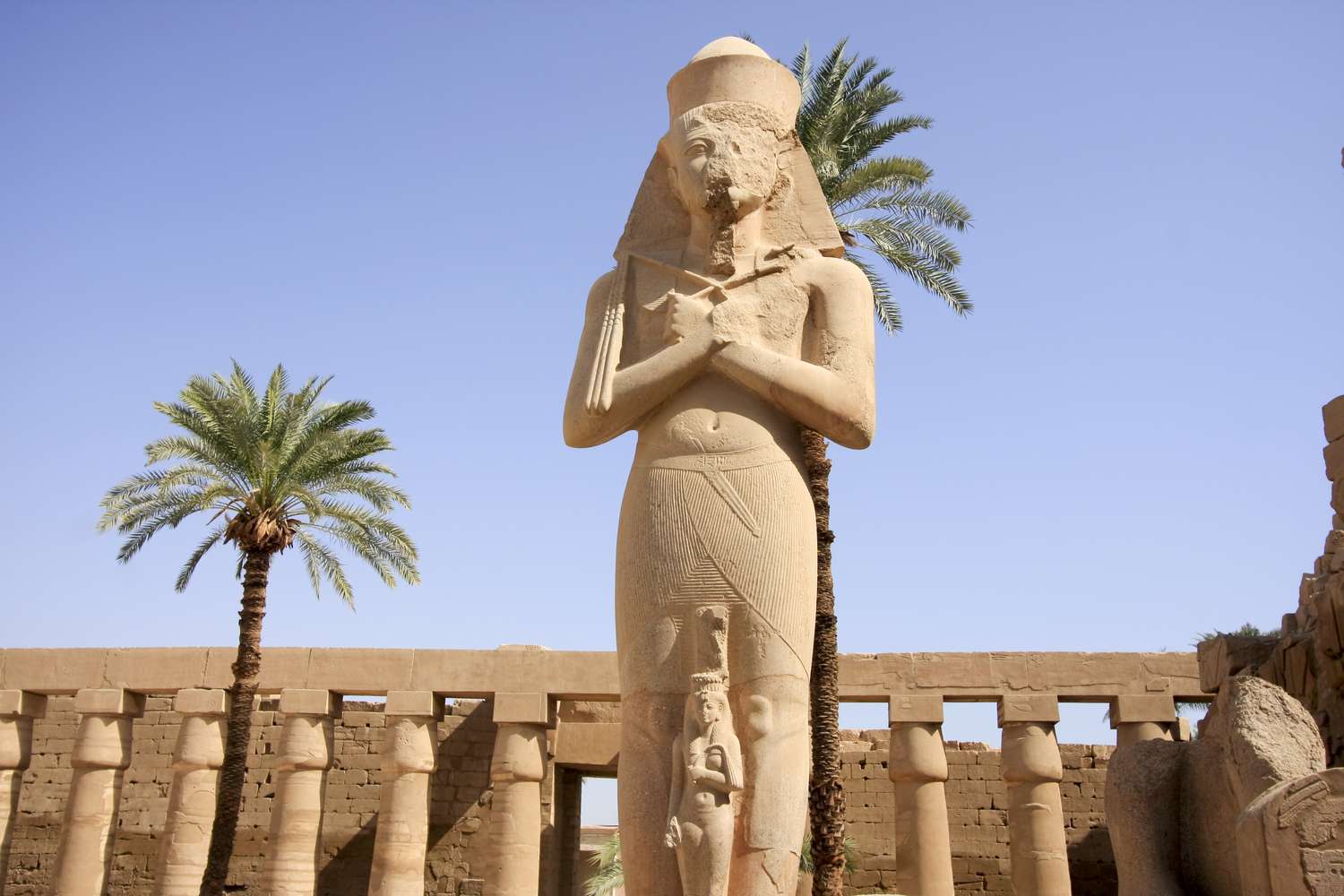
Ramses II also left major monuments at Luxor and Karnak.
At the Temple of Karnak, visitors can see statues, inscriptions, columns, and other structures connected with different periods of Egyptian history.
The famous Ramesseum on the west bank of Luxor was another important monument associated with Ramses II.
His building program was so extensive that his name appears across Egypt.
Was Ramses II the Pharaoh of Moses?
This is one of the most popular modern theories about Ramses II.
Some traditions and films connect him with the pharaoh mentioned in the biblical story of Moses and the Exodus.
However, there is no definitive archaeological evidence identifying Ramses II as the biblical pharaoh.
The association remains a historical and religious hypothesis rather than an established archaeological fact.
Akhenaten – The Pharaoh Who Changed Egyptian Religion
Akhenaten was one of the most unusual rulers of ancient Egypt.
He ruled during the 18th Dynasty and introduced dramatic religious changes.
His reign is famous for promoting the worship of the Aten, represented as the sun disk.
The Aten and Religious Change
Akhenaten reduced the traditional religious importance of several major gods and promoted the Aten to an exceptional position.
He also founded a new capital city called Akhetaten, located at modern Amarna.
The Amarna period represented a major departure from earlier Egyptian artistic and religious traditions.
Amarna Art
Akhenaten and his family were often represented in a distinctive artistic style.
Figures could appear with elongated faces, unusual body proportions, and more relaxed family scenes.
Some reliefs show Akhenaten, his wife Nefertiti, and their daughters beneath the rays of the Aten.
These images are among the most recognizable works of ancient Egyptian art.
Was Akhenaten a Monotheist?
Akhenaten is sometimes described as the world’s first monotheist.
That statement is attractive but too simple.
His religious system was certainly revolutionary, but scholars continue to debate exactly how Egyptians understood the Aten and how completely traditional religious practices disappeared.
The safest conclusion is that Akhenaten dramatically transformed Egyptian religion and royal ideology.
What Happened After Akhenaten?
After his death, many of his religious changes were reversed.
The traditional gods regained their importance.
The city of Amarna was eventually abandoned.
Later rulers also reduced the visibility of Akhenaten’s memory.
Today, the Amarna site provides travelers with an extraordinary look at a short but important period of Egyptian history.
Tutankhamun – The Young Pharaoh Who Became a Global Icon
Tutankhamun may be the most famous Egyptian pharaoh in the modern world.
Ironically, his reign was relatively short and he was not one of Egypt’s most powerful rulers.
His fame comes largely from the extraordinary discovery of his tomb.
Tutankhamun’s Tomb
In 1922, British archaeologist Howard Carter discovered Tutankhamun’s tomb in the Valley of the Kings.
The discovery attracted worldwide attention because the burial contained a remarkable collection of objects.
The famous golden funerary mask became one of the strongest symbols of ancient Egypt.
The tomb contained furniture, jewelry, weapons, ceremonial objects, clothing, and other items associated with the young king’s burial.
Why Was Tutankhamun’s Tomb So Important?
Many royal tombs in the Valley of the Kings had been robbed or damaged in antiquity.
Tutankhamun’s tomb was relatively small compared with the monumental burial places of some other rulers, but much of its funerary equipment survived.
This gave archaeologists an extraordinary opportunity to study royal burial practices.
The Curse of Tutankhamun
One of the most famous stories connected with the discovery is the so-called curse of Tutankhamun.
Newspapers helped popularize the idea that people involved in opening the tomb died mysteriously because of an ancient curse.
However, there is no reliable evidence that Tutankhamun’s tomb contained a supernatural curse that killed its discoverers.
The legend became part of popular culture because it combined archaeology, mystery, death, and ancient religion.
The real discovery is far more valuable than the myth.
What Can Travelers Still See Today?
The stories of these pharaohs are not confined to museums and history books.
Many of their monuments can still be visited.
Giza
Travelers can explore the monumental landscape associated with Khufu, Khafre, and Menkaure.
The Giza Plateau includes:
- The Great Pyramid of Khufu
- The Pyramid of Khafre
- The Pyramid of Menkaure
- The Great Sphinx
- Valley temples and other archaeological remains
A visit to Giza is an opportunity to compare the monuments of three powerful rulers from the same dynasty.
Luxor
Luxor is essential for understanding the New Kingdom.
Travelers can visit:
- Karnak Temple
- Luxor Temple
- Valley of the Kings
- Temple of Hatshepsut
- Colossi of Memnon
- Ramesseum
- Other temples and tombs on the west bank
The region contains monuments connected with many different pharaohs.
Abu Simbel
Abu Simbel is particularly important for understanding Ramses II.
The enormous statues and beautifully decorated interior demonstrate how the pharaoh used architecture to communicate royal power and religious identity.
Amarna
Amarna provides a different experience.
Instead of enormous later temples, travelers encounter the remains of a city created during the unusual reign of Akhenaten.
The site helps explain how dramatically Egyptian religious and political traditions could change.
Historical Evidence vs. Ancient Egyptian Legends
Ancient Egypt is full of fascinating stories, but not every story has the same historical value.
A useful distinction is between archaeological evidence, ancient inscriptions, later historical accounts, and modern legends.
For example, we have strong evidence connecting Khufu with the Great Pyramid.
We also have substantial archaeological evidence for Hatshepsut’s reign and her temple at Deir el-Bahari.
Ramses II left enormous quantities of inscriptions and monuments.
Tutankhamun’s tomb provides direct physical evidence about his burial.
Other claims are less certain.
The exact identity of the builder of the Great Sphinx remains debated.
The location of ancient Punt is still discussed.
The connection between Ramses II and the Exodus has not been proven archaeologically.
Stories about Egyptian curses are generally modern legends rather than ancient historical facts.
Why Do Legends Survive?
Legends make ancient history exciting.
A mysterious curse can be more memorable than a detailed archaeological report.
A secret chamber sounds more dramatic than a discussion about geological features.
A pharaoh described as a supernatural figure is easier to remember than a complicated historical personality.
But travelers can enjoy these stories while still asking an important question:
What does the evidence actually show?
That question is one of the best ways to understand ancient Egypt.
How to Get More From a Pharaoh-Themed Trip
A little preparation can transform a sightseeing trip.
Before visiting a monument, learn three things:
- Who built it?
- Why was it built?
- What evidence tells us about it?
This simple approach helps you look beyond the size and beauty of the monument.
For example, when standing before the Great Pyramid, think about Khufu’s royal burial and the organization required to build it.
At Deir el-Bahari, remember Hatshepsut’s unusual path to kingship and her trading expedition to Punt.
At Abu Simbel, look at how Ramses II presented himself through monumental statues and religious scenes.
In the Valley of the Kings, remember that Tutankhamun’s fame comes not from being the most powerful pharaoh, but from the remarkable survival and discovery of his tomb.
Travelers visiting Egypt from Hurghada can also combine historical sightseeing with Red Sea activities. Best Tours Hurghada can be a useful option for travelers who want to organize excursions while exploring different sides of Egypt, from ancient monuments to desert and coastal experiences.
Which Pharaoh Is the Most Important?
There is no single correct answer.
Each ruler is important for a different reason.
Khufu represents the extraordinary engineering of the Old Kingdom.
Khafre is closely connected with the Giza landscape and the Great Sphinx.
Menkaure represents another stage in the development of pyramid complexes.
Hatshepsut demonstrates the political possibilities of royal women and the importance of trade and monumental architecture.
Ramses II represents the military power, diplomacy, and monumental ambition of the New Kingdom.
Akhenaten represents one of the most dramatic religious transformations in Egyptian history.
Tutankhamun demonstrates the extraordinary information that archaeology can reveal when a royal burial survives relatively intact.
Together, they show that ancient Egypt was never static.
Its religion, art, architecture, politics, and royal traditions changed over thousands of years.
Frequently Asked Questions About Egyptian Pharaohs
Who was the most famous pharaoh of ancient Egypt?
Tutankhamun is probably the most famous pharaoh among the general public today because of the discovery of his tomb and golden funerary mask. Historically, rulers such as Khufu and Ramses II were far more powerful and influential during their lifetimes.
Who built the Great Pyramid?
The Great Pyramid was built for Pharaoh Khufu during the Fourth Dynasty. Archaeological evidence strongly connects the monument with his reign.
Did slaves build the pyramids?
The traditional image of huge groups of slaves building the pyramids is not supported by the strongest archaeological evidence from Giza. Evidence indicates an organized workforce that included skilled workers and laborers supported by the state.
Who built the Great Sphinx?
The Great Sphinx is commonly associated with Khafre because of its location and archaeological relationship with his pyramid complex. However, some details about its construction remain debated.
Where is Hatshepsut’s temple?
Hatshepsut’s famous mortuary temple is at Deir el-Bahari on the west bank of the Nile near Luxor.
Where is Tutankhamun’s tomb?
Tutankhamun’s tomb, known as KV62, is located in the Valley of the Kings near Luxor.
Was Akhenaten the first monotheist?
Akhenaten introduced an extraordinary religious transformation centered on the Aten. Calling his religion simply “monotheism” can oversimplify a complicated historical and religious development.
Did Ramses II build Abu Simbel?
Yes. The great temples at Abu Simbel were commissioned during the reign of Ramses II. The larger temple celebrates Ramses and several important deities.
Was Ramses II the pharaoh of Moses?
There is no definitive archaeological evidence identifying Ramses II as the pharaoh of the Exodus story. The connection remains a popular theory rather than an established historical fact.
Why is Tutankhamun so famous?
Tutankhamun became famous because his tomb was discovered with an unusually rich collection of funerary objects. The golden mask became an international symbol of ancient Egypt.
Final Thoughts
The pharaohs of ancient Egypt were not all alike.
Khufu built one of the greatest monuments in human history. Khafre helped shape the iconic Giza landscape. Menkaure continued the royal pyramid tradition. Hatshepsut created a remarkable temple and expanded Egypt’s international connections. Ramses II used architecture and inscriptions to project royal power. Akhenaten challenged traditional religious ideas. Tutankhamun became famous thousands of years after his death because his tomb survived long enough to be discovered.
Their monuments allow modern travelers to step into this extraordinary history.
But the most rewarding way to explore Egypt is not simply to collect photographs.
Look at the inscriptions. Study the reliefs. Notice the architecture. Ask what archaeologists know and what remains uncertain.
When you visit Giza, Luxor, Abu Simbel, or the Valley of the Kings, remember that every monument represents more than stone. Each one tells part of a much larger story about religion, power, technology, art, death, and the way ancient Egyptians understood their world.
For travelers planning excursions from Hurghada, combining Red Sea adventures with visits to Egypt’s ancient monuments can create a much richer holiday. With Best Tours Hurghada, visitors can explore options for discovering the country’s historic treasures while also enjoying its beaches, islands, desert landscapes, and underwater world.
Ancient Egypt is fascinating precisely because some questions have clear answers while others remain open.
That balance between evidence and mystery is what continues to make the pharaohs, their monuments, and their stories so captivating thousands of years later.